
Park City Incline · Stakeholder briefing
What Manitou proved, and five corridors worth arguing about.
A short evidence brief for Council, Vail Resorts and, if needed, the Utah Olympic Legacy Foundation. A community campaign, not a 501(c)(3) yet, and not an official City or resort document.
← Back to the campaignThe Manitou evidence.
- It was never designed as a trail. The Incline is a former scenic railway and water-works cable grade. After a 1990 rockslide the rails came off and the ties became an unofficial staircase. Colorado Springs legally opened it in February 2013 under an agreement with Manitou Springs: Colorado Springs runs the trail; Manitou runs the parking.
- Demand showed up before permission. The 2011 Site Development and Management Plan, adopted by both cities, estimated 350,000 to 500,000 trips a year while the climb was still posted No Trespassing.
- Managed, it is still a quarter-million-person attraction. Visit Manitou Springs cites about 250,000 visitors a year. Trail counters after the free reservation system launched in August 2020 showed about 251,000 climbs in eleven months. The cap is 45 starts per half hour, 1,125 people a day in summer, and it has been approached on holiday weekends.
- The town at the bottom is the business. Visit Manitou Springs reports tourism generated about $6.2 million in city tax in 2024 (48% of all city tax) and about $6.24 million in 2025 (52%). The Incline isn’t the whole tourism economy; it is the rare amenity that creates a three-hour visit and releases hungry people onto a historic commercial street.
- They kept it free on purpose. The 2011 plan rejected a mandatory user fee; counsel warned that charging could increase liability. Operations were meant to run on donations, parking, grants and sponsorships.
- Parking is the wound they never fully closed. A 2010 weekend survey found 516 cars entering the Barr Trail lot and only 142 parking there. Park City should put the stairs where parking already exists.
- Who uses it: locals, day-trippers, military and endurance athletes, destination visitors. Descent is on Barr Trail because two-way traffic on a 68% pitch is how people get hurt. Dual up/down lanes are the design answer.
What this means for Park City money
Don’t paste Manitou’s $6.2 million tourism-tax figure onto Park City and call it a forecast. The transferable mechanic is smaller: a three-hour outdoor climb that empties toward a commercial street. Even a conservative 80,000 to 150,000 climbs a year is a shoulder-season machine if those people can walk or bus to a table. Park City needs its own model before anyone quotes a dollar.
Five corridors worth studying.
Build parking last: the Manitou lesson is that the project dies in the neighborhood, not on the mountain. Grades and vertical are measured from USGS 3DEP elevation data (1 m), sampled 14 September 2026. Nothing here assumes a corridor is buildable.
| Corridor | Grade | Vertical | From parking | Land | Main Street |
|---|---|---|---|---|---|
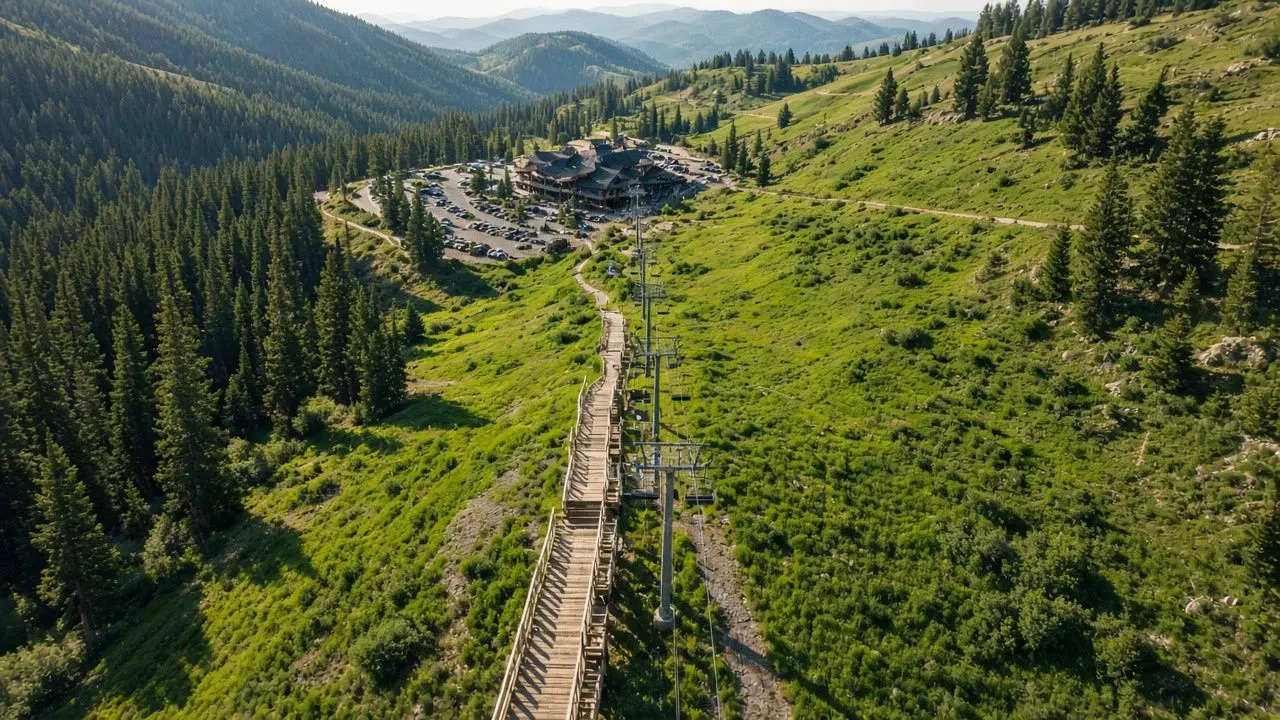
| Park City Mountain VillageThe one in the middle of town | 26% | 1,146 ft | 0.9 mi | Vail Resorts | Walk, Town Lift or a short bus ride. Climbers finish pointed at Old Town. |
| Utah Olympic Park areaThe biggest one | 40% | 1,581 ft | 1.1 mi | Unresolved | Not walkable to Old Town. |
| Deer Valley — Snow ParkThe polished one | 31% | 1,379 ft | 1.6 mi | Deer Valley Resort (Alterra) | About 1.5 miles to Main Street: bus or bike, not a walk. |
| Deer Valley East / JordanelleThe wildcard | 37%* | 1,290 ft | 2.1 mi | Mixed: resort expansion and private development | Not walkable; a drive from Old Town. |
| Canyons VillageThe easy-parking one | 28%* | 1,234 ft | 0.8 mi | Vail Resorts | About five miles: Canyons Village, not Old Town. |
| Manitou Inclinefor scale | 43% avg / 68% max | 2,000 ft | — | — | — |
* Coarse sampling only. Twelve radial transects were run from each base out to 4.5 km; the leading candidates were re-sampled at 25 m spacing to rule out cliff bands. These measure the ground, not a surveyed route.
Park City Mountain Village
Going for it: The only candidate where the climb ends near a historic main street. Manitou showed that the town at the bottom captures what the crowds spend. Parking, restrooms, food and transit already exist here.
Hard: The gentlest ground of the five. The steepest sustained pitch averages about 26%, roughly half of Manitou’s 43% average. A serious staircase, but not the steepest in the country.
Unresolved: Whether a specific ski-run fall line is steeper than a straight transect suggests. That needs a survey, and Park City Mountain’s own mountain-operations team would know first.
Utah Olympic Park area
Going for it: The only Manitou-class terrain found anywhere in the county: about 40% sustained over roughly 1,580 vertical feet, with sections at 78%. Visitor operations, parking and a 2034 story are already there, and people climb the ski-jump stairs today.
Hard: The pitch begins about 1.1 miles southwest of the parking, so it needs an approach trail. It is not walkable to Main Street, and it sits in Summit County rather than city jurisdiction.
Unresolved: Land ownership, the gating question. The terrain runs toward Toll Canyon (Basin Recreation open space) and Iron Mountain (a conservation easement since 2023). A Summit County parcel check settles it.
Deer Valley — Snow Park
Going for it: Middle ground on terrain, about 31% sustained over roughly 1,380 vertical feet, with real parking, an established base area and a shorter run into town than Canyons.
Hard: Deer Valley runs the most access-controlled product of any resort here. A free, unticketed, open-to-everyone amenity runs against the grain of how the mountain is run.
Unresolved: Whether Alterra has any appetite for public access on resort terrain at all. Worth one phone call before any further work.
Deer Valley East / Jordanelle
Going for it: The second-steepest ground in the analysis and the lowest base elevation, so the most vertical above it. New development means parking and access are being designed now rather than retrofitted.
Hard: The pitch sits over two miles out, with no Main Street connection. The land is a patchwork, usually the most complicated negotiation of any option.
Unresolved: Everything, frankly. It is on the list because the terrain scored well on coarse sampling. It has not been re-sampled at fine resolution.
Canyons Village
Going for it: The shortest approach from parking of any candidate, the largest lots in the system, a new structure and a summer gondola already running. Same landowner as Mountain Village, so it is part of one conversation.
Hard: Terrain comparable to Mountain Village without the Main Street payoff. If Vail declines one of its two bases it will likely decline both.
Unresolved: Not yet re-sampled at fine resolution, and whether the summer gondola changes the approach maths in a useful way.
Treasure Hill is not among them
Voters approved a $64 million open-space bond covering Treasure Hill in 2018 (about 77% in favor); a permanent conservation easement closed in 2025; access runs through Old Town residential streets.
What $50,000 is for, and what it is not.
A public staircase on ski terrain is a capital project in the millions. Seed money is the study that lets Council and the resort say yes or no with a straight face. Until there is a landowner, a permit path and a fiscal home for the funds, nobody should be raising construction money. The clean version is a restricted project fund or fiscal sponsor (Park City Community Foundation is the obvious local conversation, and it is not lined up yet).
| Seed line | Amount | What it buys |
|---|---|---|
| Survey, GIS, Payday overlay | $10,000 | Map each corridor’s measured pitch against a surveyed fall line so the vertical is not a guess. |
| Concept alignment memo | $15,000 | Dual-lane stairs, drainage sketch and a winter-closure plan. Not stamped construction drawings. |
| Parking and mobility memo | $6,000 | Prove the Village lots and transit can absorb climbers without dumping cars on Old Town streets. |
| Legal, entity, insurance | $4,000 | Who holds money, who speaks to Council, who is on the hook if someone gets hurt at a site walk. |
| Visuals and Council packet | $5,000 | Aerial overlay, leave-behind brief, meeting materials. |
| Outreach and operations | $3,000 | Domain, list, print, neighborhood meetings. |
| Fees and contingency | $7,000 | Platform fees (~2.9% + $0.30) and the lines that always run over. |
| Seed total | $50,000 | Studies and a mandate. Not timber, not concrete. |
The later build is a Class 5 concept range, $2 to $5 million, until a survey and geotech exist: dual-lane stairs at this length, drainage, retaining, a summit rest area, design and a small maintenance reserve. Manitou inherited railroad ties. Park City would be building on purpose.
Permits, insurance and a mountain already in use.
Payday is Vail-controlled resort terrain, not City open space. A free public staircase on private ski land is first an insurance and operations problem for the resort: who is covered when a climber falls, who closes the corridor for snowmaking, who staffs a rescue. Summer bike and hike products already live on this mountain: the stairs can’t occupy the paid downhill bike line or treat guest restrooms as public infrastructure. Constructed stairs need slope, drainage and wildlife review; City and county permits still apply; Forest Service ground would bring NEPA.
How to talk to Vail, and what if they pass.
Lead with what they keep: the land, the hours and a veto. They get Village food and retail in May and October without spinning a chair, and a community story. A seasonal pilot, stairs for one shoulder season, is an easier first yes than a permanent staircase of unknown length. Canyons stays inside the same Vail conversation. Snow Park and Deer Valley East are Alterra conversations. Utah Olympic Park is the only Manitou-class terrain, and a parcel check comes before any drawing.
Signers are the constituency. This brief isn’t choosing the corridor. Add your name
Sources: City of Colorado Springs Manitou Incline pages; 2011 Manitou Incline Site Development and Management Plan; Visit Manitou Springs 2024/2025 annual reports; Colorado Springs Gazette reservation-year trail counts; FIRS meeting minutes (eco-counter tables); Park Record / TownLift coverage of Treasure Hill and the Utah Olympic Park development agreement; Vail Resorts summer operations notes; Wikipedia lift table for Payday Express vertical.